
Tariff Refunds – Last week, the U.S. Supreme Court ruled that President Donald Trump exceeded his legal authority in imposing broad “Liberation Day” import tariffs under emergency powers in 2025. More than US$175 billion of tariff revenue has been thrown into legal uncertainty as companies now pursue refunds from the government for amounts paid on various international imports. This drove a softening in the U.S. dollar as traders reassessed risks tied to U.S. trade policy unpredictability. In a press conference, Trump predicted litigation over the refunds, saying “We’ll end up being in court for the next five years.”
Transatlantic Uncertainty – As a result of the Supreme Court’s nixing of Trump’s Reciprocal tariffs from last April, various trade agreements between America and countries across the Atlantic – like India, the U.K, Singapore (albeit the Pacific) – are facing an unknown conclusion. These special tariff ‘discounts’ may now be meaningless, as Trump retaliated with a planned blanket tariff of 15% on all imports to the U.S. Trade uncertainty is back!
AI Scare Trade – Clawdbot, an AI tool that allowed the bot to undertake human prompted tasks autonomously without user intervention or work, went viral in the last week of January across tech communities. Seen as the next phase for retail AI capabilities - the consequent advancement in efficiency and productivity it yields for humans behind a computer screen, triggered sell offs across tech stocks as traders bet on its disruptive potential versus traditional software business models.

Source: ChatGPT – ‘Clawdbot wreaks havoc in the city’
U.S v Iran, Again – America has built up its military presence in the Middle East recently – particular against Iran’s nuclear weapon capabilities. “The principle is very simple: Iran can’t have a nuclear weapon. If they try to rebuild a nuclear weapon, that causes problems for us,” said VP JD Vance to pressers. Washington is pressing for strict long-term constraints on Iran’s enrichment activities and Tehran pushing back while insisting its program is peaceful and seeking sanctions relief. Both nations are set to meet in Geneva for a third round of talks to reach a diplomatic deal and try to soften rising political tensions in the area.
SA’s Budget Blessings – The finance minister delivered an optimistic government budget speech yesterday – outlining a decent fiscal outlook (budget deficit as % of GDP lower and government debts more stable), buoyed by stronger revenues from mining windfalls the past year. Additionally, there will be some tax relief and friendly incentives for individuals and businesses via inflation adjustments to personal tax brackets, higher tax-free investment limits, and expanded exemptions for small business capital gains.
Gold crossed the $5,000/oz mark and then some, reaching a new record high of $5,593/oz at the end of January. Since then, the price moved lower to around $4,500/oz, before recovering again to the $5,200 level.
Since hitting its late-January all-time highs, gold experienced a softening pullback driven by strong risk appetite, profit-taking and likely liquidity and risk management by global trading desks. Since then, the gold price has recovered on the back of strong underlying fundamentals (extreme geopolitical uncertainty, trade alliances fundamentally changing and U.S and other global economies’ high debt and expanding fiscal positions).
“Typically, once an asset becomes mainstream, hype can often creep in. The recent volatility is a reminder that sharp price swings can happen,” said Tan Siew Lee, OCBC’s Head of Group Wealth Management. In a recent article on Asianbankingandfinance.net, Tan notes that whilst precious metals play a stabilising role in a portfolio, allocations should stay measured.
“Those with little or no exposure should consider building positions gradually — taking advantage of dips and staying focused on their long-term goals rather than reacting to short-term market noise,” Tan added.
In terms of pundits’ views on forward-looking gold price moves, Standard Bank’s Adrian Hammond, the bank’s head of precious metals, said that gold is likely to soar above $7,000 an ounce, and possibly even breach $10,000.
In a session at the African Markets Conference in Cape Town this week, Hammond stated, “We have a high conviction that gold will end above $6,000 this year. For next year, our base case is $7,000 depending on your view of interest rate cuts, but we think three cuts will get you there, and any further cuts will get gold between $8,000 and $10,000.”
The yellow metal was last seen trading at $5,201/oz.
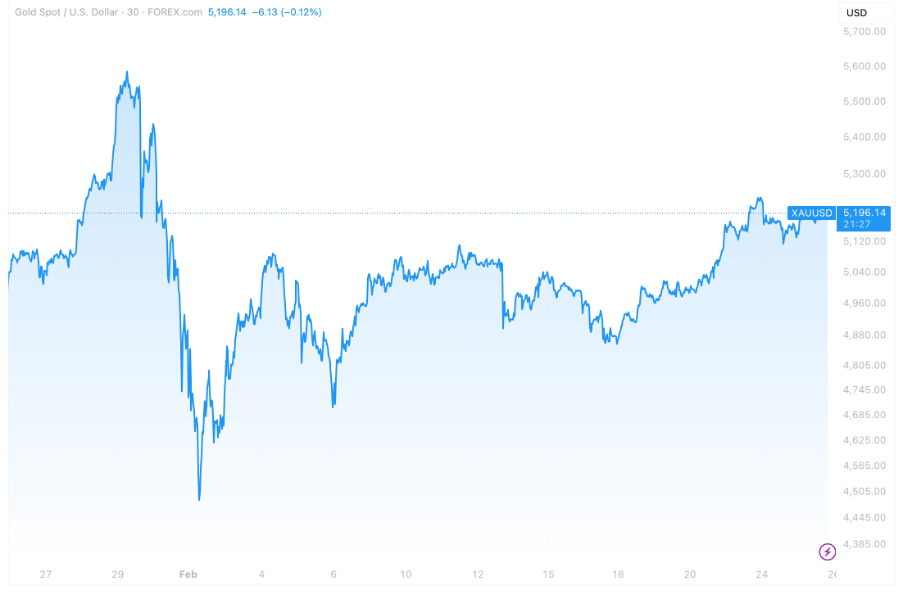
Source: TradingView – XAUUSD (1 month)
