What’s been Happening
Oil and Diesel Supply Constraints Keep Energy Costs Elevated Across Industry & At The Pumps –
US diesel averaged $6.28 a gallon on 10 October, up from $3.68 a year ago (roughly +70%) and just off the record $6.53 set in late September. South African motorists are feeling the same shock: the 7 October adjustment lifted wholesale 50ppm diesel by R2.84 a litre to a record R31.95 inland (R31.08 at the coast), on top of September’s R29.11, which was already about 50% above a year earlier. At the pumps, that puts diesel at roughly R33–R35 a litre, with petrol breaking R30 a litre for the first time. Miners have reported fuel bills more than double their guidance assumptions, and container carriers are paying far more to move cargo, with bunker fuel up from about $518 a ton in February to around $901 from March to May. Those costs are feeding through into freight surcharges, food and materials prices. Interestingly, this week the cost of shipping a container from the US to China briefly exceeded that of a spaceflight!
Supply remains the problem. Hormuz traffic has collapsed, with one recent day recording only seven transits against a 10-day average of 14, and Saudi Arabia’s East-West pipeline, which carries around 5 million barrels a day to the Red Sea, has been shut since the 10–11 September drone strikes. The Houthis then fired missiles at Riyadh over 10–12 October, which does little to encourage a quick reopening. Washington’s answer is a Russian diesel deal (over 300,000 tons now, 500,000 in November, 1 million after, under a sanctions waiver to 7 April), but analysts doubt the volumes are large enough to matter with Brent Crude still above $100 a barrel.
Dollar Strength and the Bond Rout Continue as Yields Reach 24 Year Highs –
The Fed raised rates 25 basis points to 3.75%–4.00% on 16 September, its first hike since 2023. The 10-year Treasury yield closed September at 5.29%, its highest close since 2002, and touched 5.33% on 1 October, with the 30-year at 5.68%. The dollar index rose to around 102.5, an 18-month high. A weak jobs report briefly cut October hike odds from over 70% to around 20%, but a December hike is again the base case on CME FedWatch, with estimates ranging from roughly two-thirds to above 80%.
Prominent bond voices expect yields to keep rising. Jeffrey Gundlach says the Fed should have hiked 50 basis points rather than 25, that inflation is “not getting better” and is heading toward 5%, in an economy resembling the 1970s. George Noble calls bonds an “outright short” on unsustainable fiscal policy. Their shared logic: heavy issuance, sticky inflation and an oil shock all pushing the same way.
An Incoming US Debt Crisis in Three Years as U.S Enters Dalio’s ‘Go Broke’ Cycle –
Ray Dalio told Bloomberg on 6 October that the US faces a debt crisis “in three years, give or take two” on the current path. Washington collects roughly $5.5 trillion in revenue yearly and spends about $7.5 trillion, an income statement deficit of $2 trillion - near 6% of GDP. The annual interest expense on US Debt is now above $1 trillion a year, close to a fifth of the budget. In his big-debt-cycle framework, borrowing increasingly pays interest on earlier borrowing (from past bond issuances) and therefore room to adjust shrinks;
With the U.S economy growing at 4-5% a year, he wants the deficit cut to around 3% of GDP, to make it sustainable. But this looks hard while the Fed is hiking rates and yields are at 24-year highs – at 6% deficits, the debt keeps growing faster than the economy. This means the market needs to keep buying ever more Treasuries, so the debt load doesn’t slow down – and buyers will need even higher rates to make it attractive buys.
In his latest note on X.com, Dalio says the US government will issue about $2.1 trillion of net new marketable debt this year while also refinancing roughly $10 trillion of maturing debt, just as demand from their traditional buyers softens. Foreign investors hold about $9.3 trillion of Treasuries, around 32% of the total, but their buying is slowing, and Japan and China may pull back further. More supply pushes yields up, higher yields raise borrowing costs and add to the debt, and that loop, he warns, is unlikely to break until higher rates weaken the economy and markets enough to rebalance supply and demand.
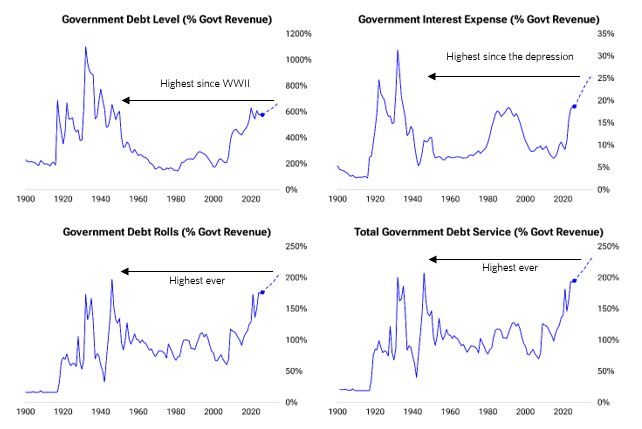
Source: X.com – Ray Dalio. Article: The Numbers Behind the Bond Bear Market, 14 October 2026.
Meanwhile, Mohamed El-Erian has flagged the disconnect between US equities at record highs on narrow technology leadership and government bond yields at multi-decade highs. In our view, a gap like that tends to close either with equities falling or with investors moving out of government bonds into assets that don’t depend on a government’s ability to fund itself – like gold.
South African Economy and Markets: Rates Rise, Inflation Stays Contained, Confidence Fragile –
The Reserve Bank unanimously raised the repo rate 25 basis points to 7.25% on 23 September, citing upside inflation risks from fuel prices even though headline CPI eased to 4.4% in August from 5.0% in June. Governor Kganyago noted the rand has held up well, containing import prices. Higher global yields and a stronger dollar still weighed on local assets, with the JSE All Share down 1.3% in the week to 25 September.
Sentiment is recovering from a low base. FNB/BER consumer confidence improved to –13 in the third quarter from –19, with low-income households at their highest since the third quarter of 2024, though middle- and high-income households recovered only about half their second-quarter losses. SACCI business confidence reached 125.4 in July, its best since March. The economy is holding steady against a hostile backdrop, but a rate hike is now reaching household budgets just as fuel costs soar.
What’s Happening to Gold
Gold has had a difficult few weeks. After around $4,321 in our last edition, it fell about 3.3% in the first week of October as 10- and 30-year yields hit their highest since 2002 and the dollar strengthened. It found a floor around $4,065 on 7 October and has rebounded about $140 to $4,187 today as 30-year yields eased after a well-received bond auction and oil pulled back.
China is the clearest support underneath the price. The PBoC added about 21 tonnes in September, its 23rd consecutive month of buying and its largest monthly purchase in three years. At household level, China Gold Association data cited by China Daily show first-half bar and coin demand up 28.4% to 339 tonnes while jewellery demand fell nearly 34% to 132 tonnes: households are moving from gold to wear to gold to hold. A positive sign for bullion prices!
Behind this sits the remonetisation of gold. In his July piece on the “six vectors” of remonetisation, Incrementum’s Ronald-Peter Stöferle argues gold is regaining relevance as the ultimate reference asset, not returning as a gold standard. Two vectors matter most now: the private allocation gap, since pension funds, insurers and family offices hold minimal gold and even a small shift out of bonds could create enormous demand; and silent recapitalisation, where central banks value gold at market prices so a higher price acts like fresh equity for indebted sovereigns. His illustrative estimate of $7,000–$10,400 an ounce (backing a third to a half of base money) is his view.
Near term, gold depends on real yields and the dollar. A hot inflation print in the U.S (a release comes out today) or a more hawkish Fed is the main downside risk; yields failing to break above 5.33%, a softer dollar or fresh strain in sovereign bonds (Dalio’s debt cycle) would favour a recovery. The structural case of central bank buying, Chinese household demand and an unfixable sovereign debt problem is unchanged.
The yellow metal was last seen trading at $4,143/oz.
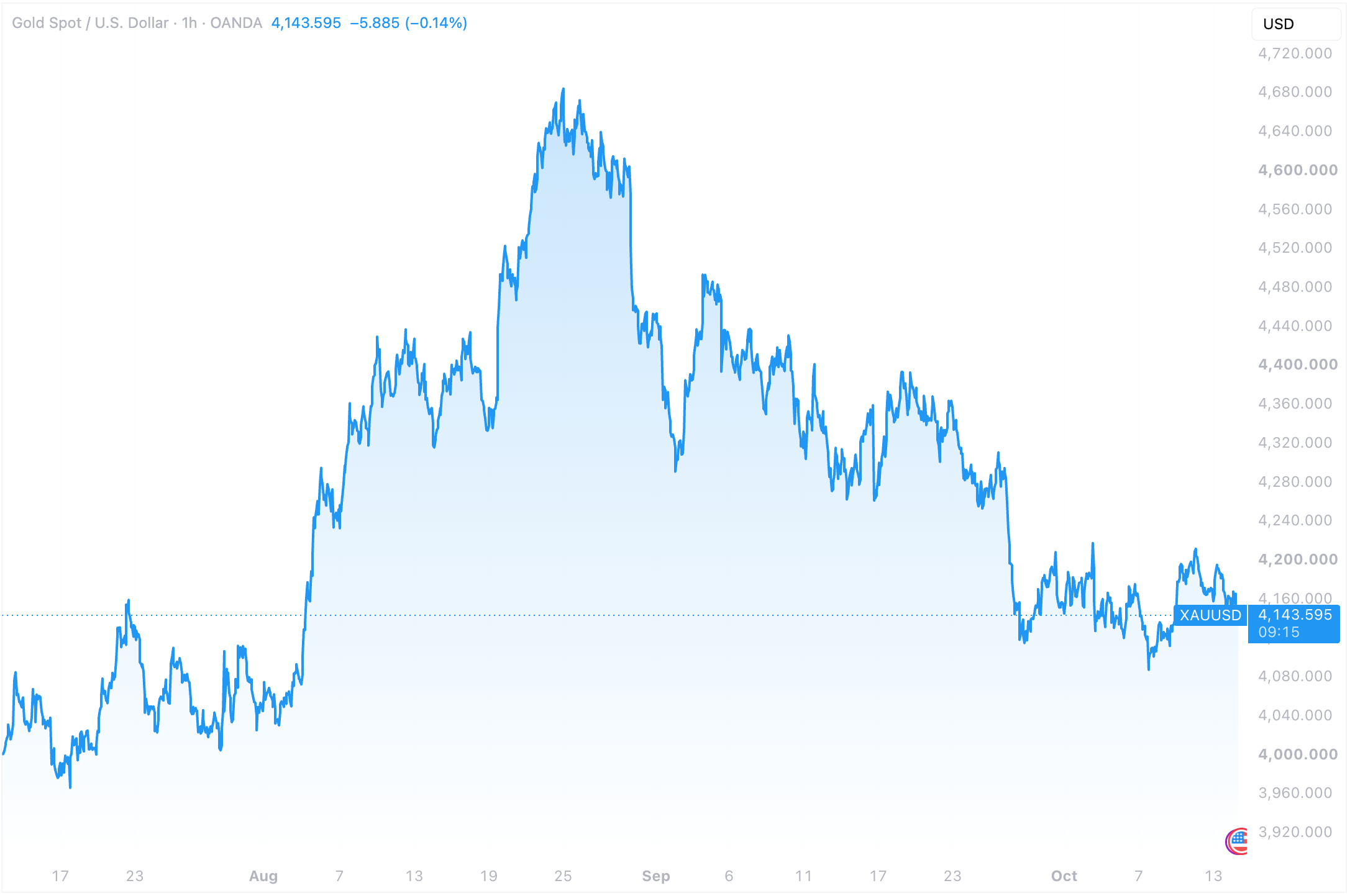
Source: TradingView – XAUUSD (3 month), 14 October 2026.